
Queer, a novella by William S. Burroughs which recently was adapted and directed by Luca Guadagnino, released on December 13th of 2024. The novella in my opinion is better (it always is) however I don't think that the artistic liberties Guadagnino took were necessarily bad, it's piece of art remodelled from the original, altered to fit the silver screen.
A brief history; Queer was partly written in 1952 as a sort of sequel to Burroughs'first success "Junky", while waiting for his trial for killing his "Common law" wife Joan Vollmer. The many attempts he made for the book to be published were turned down until later in 1985 when talks of Queer being released started, Burroughs was hesitant to publish it, stating in the introduction that it was "painful to an extant I find it difficult to read, let alone to write about" it has now been recently restored by: Oliver Harris (side note there is a really good Interview with Professor Oliver Harris by RealityStudio) they Merged the original manuscript and the written text of the 1985 edition while using what fragments of the original manuscript could be salvaged, this has now been published as Queer: 25th Anniversary Edition (Penguin Modern Classics). Oliver Harris was also credited on the film as a literary consultant on Burroughs, which on the recent second watch I was pleasantly surprised by! Here is also a link to How Prof. Oliver Harris helped Luca Guadagnino adapt QUEER'. The blur of fiction and reality like many of Burroughs books, novels, novellas and poems -a bit redundant but I love to say them in order- parts of which are often taken from his life though it's hard to find the lines of who Lee is and who Burroughs is and where they interlace.

The book flips the political ideologies of the time on its head and rips them to shreds, in a time when queer culture had been stripped away or suppressed like the lavender scare mentioned in the book, and the refusal to publish an openly homosexual book, however years later when the novella was released Burroughs still denied it being even slightly about homosexuality, It is a deep cut into William S. Burroughs'life. The semi-autobiography follows his desires of love and later on control mixed with withdrawal from junk (in reality still very much using, while writing the book). It must be stated that William Lee is not merely William Lee... he is William Lee, sorry! that's confusing He is William S. Burroughs and what could have been between him and Adelbert Lewis Marker or his fictional counterpart Eugene Allerton. Personally it is a novella that twists you inside out while seemingly still being able to taste the threats of something emerging, about to be born- that being Naked Lust sorry I read that wrong 'Naked Lunch'(Allen Ginsberg misread the phrase "a leer of naked lust wrenched" as "a leer of naked lunch" inspiring the title of the book) The book ends abruptly yet slowly as Lee desperately searches for any trace of Allerton, inter-cut with vivid hallucinations about a man that never could truly connect to Lee with or without yage, much can be said similar to the end of Burroughs real-life relationship with Marker In August 1953, Burroughs wrote to Ginsberg, "I never heard from Marker after I left Mexico, though I wrote ten letters to his home address in Florida" He also mentioned in his letter to Ginsberg that he "wrote Queer for Marker" (Letters 138). Supposedly meeting Maker in 1952, after that we cannot be certain whether they meet again but what is certain is that both Marker and Joan Vollmer where a main force (possibly in conjunction) for his writing, Burroughs also mentions Marker well rather Allerton many times both in his fictional writing and in his personal diaries.
"Lee could see the boat anchored at twilight."
In much of Burroughs books there is surreal and vivid imagery like for example the use of vibrant depictions of centipedes both in the novella and film "Men changing into huge centipedes...centipedes besieging the houses... a man tied to a couch and a centipede ten feet long rearing up over him. Is this literal?" and even going so far at the end of this paragraph to ask "What is the meaning of the centipede symbol?" Great question, so let's try to answer it, while this is the only mention of them in the book, that nevertheless does not take away for the interesting symbol of fear that they are while representing Allerton as a character, he is the centipede elusive, dangerous and it's taken over Lee, he is consumed by it, this obsession and the burning desire to connect, the inevitable loss is "rearing up" at him because he knows what will happen, we know what will happen.
However, what is not mentioned in the film are vultures, brought up in Queer and the opening of The Wild Boys and other short stories, this could overall be the looming presence of William S. Burroughs's deceased wife Joan Vollmer as in the introduction to the 1985 release of Queer he mentions it was an unconscious force for writing. The vulture could also foreshadow what is to come in the book "Thousands of vultures roosted on the houses and walked around the streets, pecking at offal. Lee kicked at a vulture, and the bird flapped away with an indignant squawk." and how Lee is much like a vulture picking apart other people showing much disinterest in those around him but still desiring the body's flesh, a mind, another human being to discover sexually or otherwise.
I love how Luca Guadagnino described the film "This is a movie about the fever dream of connection and disconnection." He said while interviewed by Variety. The film is, I think, more important than ever in a time when we as people feel so disconnected from the world around us and the people in it, especially in a time like now littered with fear of possible conflict much like the 1950s. The actors fit perfectly, Daniel Craig playing William Lee and the seemingly upcoming star Drew Starkey as the cold love interest Eugene Allerton. Many of the hallucination scenes are cut from the film but they have been adapted and some completely new ones have been added this is mostly the artist's intentions but it could have been that some of the scenes were cut for time as it seems one of the first off-putting scenes in the book was carried over in the screenplay but did not make it to screen, this could be due to the multiple copies of Queer. The one thing I love about Luca Guadagnino is the end of his films often leave you raw and aching -well for me anyway-. The end is slow it fades out knowing that he never caught his "Fish" similar to the feeling you get at the end of the book...wanting more, yet cold.
I only realised the second time round, but the opening montage almost predicts the entire story: in clothing, glasses, personal items...first separate, then coming together, lingering and slowly coming apart.

Guns are almost always present, whether that be in Burroughs' real life or his art. An example of this would be one of my favourite paintings, which consists of two shotgun blasts, red and black sprayed acrylic over skeleton stencils, creating phantoms of people, titled "Out of the Closet" it was made in 1990.

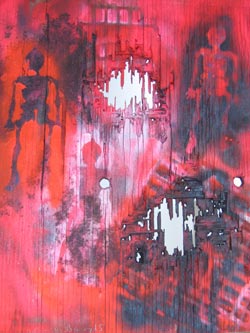
Guns are always in the background, looming especially in the film. I think the best instance of this would be the very first sex scene where Allerton comes round to Lee's place and as the tension increases, underneath one of the pillows there is a gun slightly visible, I was thinking "what else would someone have that was gunmetal black under your pillow in the 1950s?", in the context of William S. Burroughs it makes complete sense (well as much as it can) as he had a fixation on guns, he Really Loved his guns, although I can't find a definite reason as to why one of the main possible reasons was that he liked the unpredictability of them. In the film, it feels uneasy when you see this glint of metallic black while skin is around it, this beautiful moment of two people making love somehow overshadowed by this weapon linked to death and violence.

As I mentioned earlier some of the hallucinations that were featured in the book were cut or changed, however this is a whole new dream. After getting drunk and high Lee has a whole hallucination sequence: from seeing a man sharpening a knife, the same knife Lee bought (most likely) to the people he knows walking in prison uniform and later a woman saying "Aren't you queer?" However one part that stuck out to me was the two feet severed with a centipede crawling up them, near the end of the sequence. This could be a call back to "The Junky's Christmas" I think for the most part the feet are another way to show disembodiment and disconnect while even though the Centipedes in the film are a slightly different motif, I think rather than infatuation, its oppression and suppression whether that be Allerton sexuality or the society they live in and the pressures that are on both men. The centipede is what pulls them apart. Another main part of this illusion would be how almost everyone around is dressed in prison attire. I think this was a way to implement the Penal Colony dream even though not the same but definitely another way to explore how Lee feels exiled and distant.

I think the most moving and vivid images in the film are when they at last find and take Yagé/Ayahuasca together, in the jungle, these scenes are some of the first tastes we get of how grotesques this film can be although this is not out of the blue there is a thematic build to this point in the film, however, I still found it uncomfortable. If you haven't seen many of Luca Guadagninos other films, you might just think he's good at tennis but he is also good at the gore too (like Bones And All) the beginning or rather the start of the trip is horrific and slowly builds this feeling of unease, In the screenplay (by Justin Kuritzkes) this event is described as "A fleshy balloon [that] starts to from his mouth. A look of total terror flashes across Lee's eyes as the balloon gets bigger and bigger." This is a horrific yet moving image, all the more bizarre when "in the centre of the puddle, Lee's heart, detached from his body, is beating on the ground. Allerton's balloon bursts too, and his beating heart flops onto the ground next to Lee's." They are finally open to one another, their hearts open, on the ground, exposed and visualised in front of them. Guadagnino talked about this image that he had pursued for almost "40 years" with Denis Villeneuve from Variety after an actual life experience. The scenes of both men entangled, their hands and arms under each other's skin, merging together, is weirdly moving, yet beautiful. At that moment, they are connected and one with each other, which makes the fall of their relationship all the more hurtful. It's a fever dream and leaves you sitting there thinking: "what did I just watch and was this in the universe of the film or all just in their heads?"

I probably could spend hours, years maybe just talking about the colour theory of the clothing and over design choices in this film -and many others-, very much how I feel about the costume designs done by Denise Cronenberg which are stylised yet believable, and the suits she uses? Spectacular!

Much like the costume in Queer by Jonathan Anderson, he has somehow made every character stand out with many signature pieces whether that be Lee's Cocaine white suit.

or Allerton purple jacket, thin and form fitting shirts or Joe Guidry (played by Jason Schwartzman) and his patterned and textured flannel shirts.
Anderson stated when interviewed by Vogue that "at the beginning [Lee is] wearing this shirt that's optic white... [There's] this idea of it being pristine, like cocaine. By the end of it, after his heroin trip and everything else [it starts] getting darker and darker, it becomes dirtier..." You can see this slow descent through the film by the end dressed in almost full black, a slow and eerie way to show loss and struggle through just a character's colour palette. He also mentions in that same interview that all the pieces were sourced for the 1950's to give it a lived-in look and texture. You can see this especially with Lees clothing, for instance, the back of the white jacket its thin and has discoloration and there are slight snags at the back of it, the lighting in the final hallucination makes the wear on the suit more obvious in the top down light, reliving the missing and pulling in the threads of fabric.

The purple jacket, I think by far, is the most important piece in the movie even though it shows up only a handful of times. The deep purple colour represents how he is unattainable, rich. True purple is not often found in nature, especially dye, It is well fitted like the rest of his light and delicate clothes, all of them still convey a lived-in feel, yet still clean and pressed, form fitting, this helps to make him look young like a boy you might see in an advertisement for the 50's.

My favourite detail by far is after Allerton is detached from William Lee, consequently the next time they meet he wears a grey suit jacket and matching trousers with a darker hat, this implies how he is closed off and in his own way distancing himself from Allerton, I feel after this moment you can see it's going downhill, personally it makes me feel a bit uneasy, him not wearing that staple suit feel almost out of character and the change very obvious the white shirt might still be there but his hesitant demeanour shows his reaction to being shunned establishing how infatuated he is.
Principal photography began in Rome, Italy. Much of the film is shot with set pieces and they are amazingly crafted. The primary restaurants, hotels and bars are phenomenal, not to mention the set dressing is beautiful, the cigarette packets or even the needles have this old quality, believable. Everything feels within the confines of the time period while still being surreal, the main bar, the Ship Ahoy model after the Bounty Bar at Monterrey and Chihuahua streets, is bright and large the design team based this set on third-class sections of Art Deco ocean liners like the SS Normandie,

whereas Lola's modelled after Tatos bar adjacent to mexico city college, in the film has a heavy Russian influence. the avaunt-grade paintings on the wall are a great example in the scene where Lee and Allerton go out together, lighted with soft orange making it feel less stark and more romantic and soft contributing to this odd routine that Lee pulls and solidifying it as almost sincere.

I feel that there are many seamless transitions from set to real filming locations and What I didn't know until doing research and having a brief conversation with a friend was that much of the wider landscape shots were done by Miniatures. I think they not only blended this well but it helped to keep the surreal tone. They filmed in Quito, Ecuador for the last act of the film.
Trent Reznor and Atticus Ross were the main composers for the original soundtrack although there are other tracks by artists like "All Apologies" performed by Sinéad O'Connor which gives it a gentle feeling, I think it adds to the overall atmosphere, another big hit they use this time not a cover was "Come as You Are" performed by Nirvana which is an interesting choice that not only fits the scene but also could be a small nod to the lead singer meeting Burroughs in 1993 and working on a few projects together notably 'The "Priest" They Called Him'. although the song "Come as You Are" released in 1992 I think it still fits within the confines of the film, exploring in this scene the meeting with Eugene Allerton as slowly the camera pans up to him from the Cock fight below, helps to establish that in that moment Lee felt something an overpowering attraction. Other honourable mentions are "Musicology" performed by Prince. "Vaster Than Empires" performed by Caetano Veloso, Trent Reznor and Atticus Ross...even though the whole track list is amazing, there are always a few that stand out in a scene.

If there is one thing Trent Reznor and Atticus Ross are best at when composing a track is the ambience, the way the music perfectly fades to noise or a sound, dialogue or the way the music slowly fades to a drown almost crescendoing but then fading into silence, mimicked by Lee and Allerton relationship. The original songs for the soundtrack are heart-wrenching, fitting the mood incredibly well yet still having that touch while changing to fit the setting and tone of a film like Queer compared to the more electronic/techno soundtrack of Challengers. My favourite song, maybe from a soundtrack ever, has to be "Love Would Shatter" It's agonising but still yet loud, it's natural but man made! it is by far the best song that fits into the slots of the main relationship in the film while being the best to cry at night (in my humble opinion.)
Daniel Craig playing an oddly pathetic and tragic role was not on my Bingo Card, I had only seen him as James Bond -I think as most people had- so I was a bit shocked to see him cast in this, although I never doubted that he would be brilliant, however would he be able to capture the private life of William S. Burroughs? to some extent, yes!, even though we can never truly know what he was like (unless you met him), Daniel Craig transformed the role of William Lee into a fascinating, complex, raw and relatable character, giving a face to the leading character.
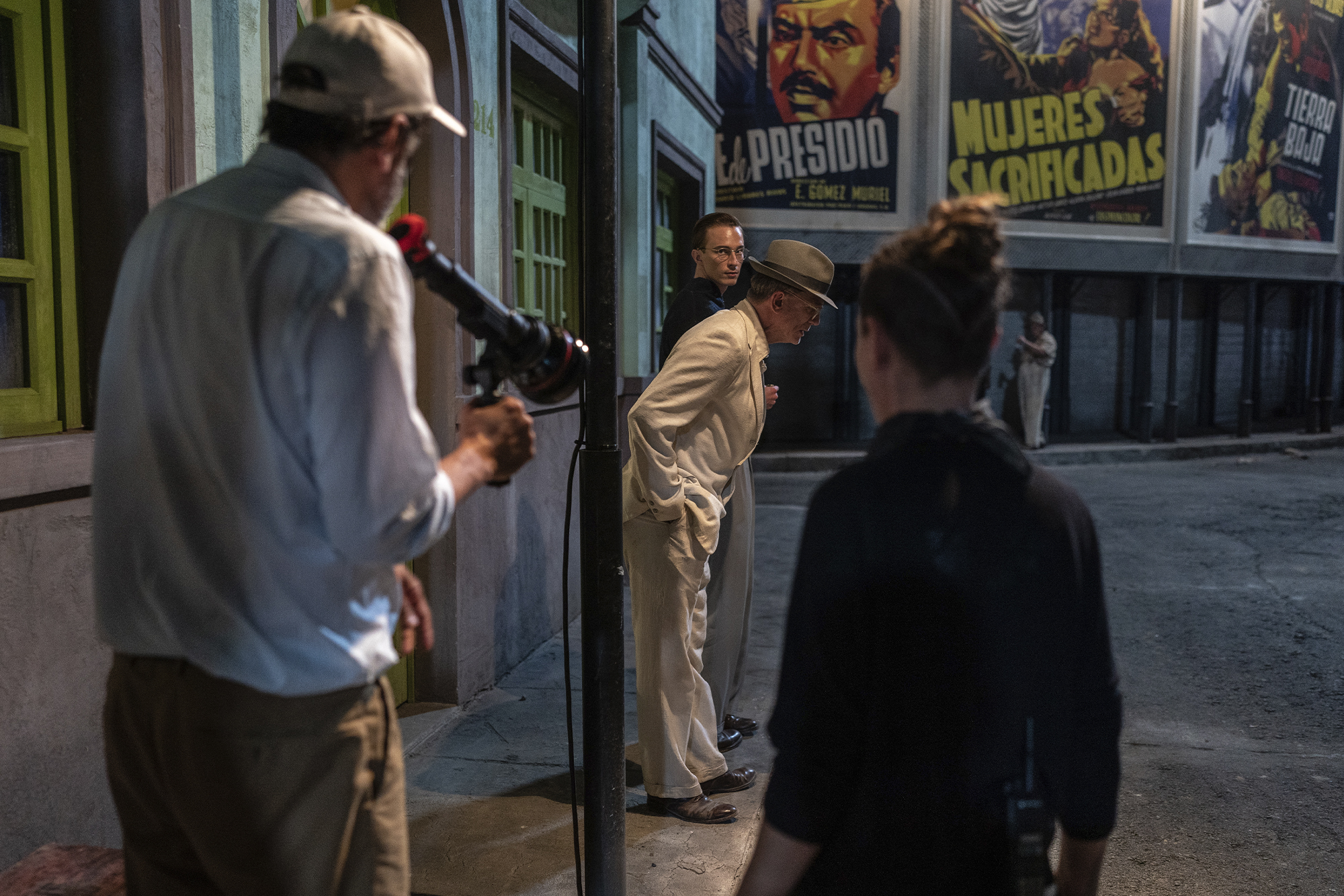
Drew Starky, although relatively new in the film industry, is not bad at all; He fit the role perfectly, and I was pleasantly surprised when I saw the way he acted his character, even though, originally, I didn't expect much from the Outer Banks actor -sorry-. He gives off harsh and unflinching, playing the role of emotionally (and physically) distant both to the audience and Lee extremely well, the unattainable idol and at some points just an image. The supporting cast was great. Jason Schwartzman as Joe Guidryis is absolutely electric! Every line and movement has so much meaning and energy. The scene after Lee gets up to talk to John Dume a lantern boy -played by Drew Droege- Guidryis touches Lees seat affectionately it is odd of course but endearing. I think the cast as a whole was amazing.
"They drove into Quito in a windy, cold twilight"
Overall, the book is very cold as I have mentioned, it has a very peculiar feel that I can't ever describe fully ("No time to fuck" in the words of Paper Bag by Goldfrapp fits the atmosphere) but I'll try my best with what's in my lexicon, in the novella you are very aware that Lee is in love and utterly infatuated with Allerton, there are many instances of this bitter detachment seen in Eugene Allerton"Fish is right," quipped Guidry. "Cold, slippery, and hard to catch." but also in Lee like his dream of being in a Penal Colony, there is also another work that Burroughs wrote with a similar tone which is a short story form the collection Interzone titled similarly "Dream of the Penal Colony" which details Lees fear of exile and loneliness. The moments that showcases this cold feeling of indifference are the end of Mexico City Return two years later and the ghostly way the town feels "Mexico City is a terminal of spacetime travel, a waiting room where you grab a quick drink while you wait for your train." I think overall, they tried to capture this disjointed feeling and even though they partly succeed, the book pushes this cold and harsh rejection further and the same can be said about the political tones in Queer never being afraid of controversy and cruelty, the film however tries to deviate from this, that then becoming my main gripe with the whole thing, much like the adaptation of Naked Lunch by David Crononberg (Who I am MADLY in love with) talked about how it was a fusion of his art and Williams S. Burroughs art, that without one another the film would not exist, even though some people have said it didn't capture the energy of Naked Lunch you can still appreciate this beautiful amalgamation, I think Luca Guadagnino tried to do the same thing while adapting Queer and although I admit it was a well done film, I don't feel it was a 100% accurate adaptation as I felt that lots of the main plot lines of the novella where cut. I can't imagine adapting this type of book from a man whose work will forever be difficult to adapt, which leads me to…
I think my biggest problem is that much of the political and social commentary is made quite subtle in the film, the book, on the other hand, less so. I think if I recall they cut the whole Bobo Routine short however it drags on in the book "It was a wise old queen— Bobo, we called her—who taught me that I had a duty to live and to bear my burden proudly for all to see, to conquer prejudice and ignorance and hate with knowledge and sincerity and love." which becomes a main point in the film very heartwarming, however you wouldn't think that later in the routine you would read "Poor Bobo came to a sticky end. He was riding in the Duc de Ventre's Hispano-Suiza when his falling piles blew out of the car and wrapped around the rear wheel. He was completely gutted, leaving an empty shell sitting there on the giraffe-skin upholstery. Even the eyes and the brain went, with a horrible shlupping sound." The political context of why this statement was made was specifically to mock "The homosexual in America" by Donald Webster Cory, rejecting and punishing the core idea of the Paper, that being "democratic spirit" a Solidarity among Homosexuals. Lee in the novella frequently has fantasies of control, whether that be crushing personal thought "Give me one year and the people won't have any opinions." or control and altering Eugene Allerton. "You'd be so much nicer after a few alterations. You're nice now, of course, but you do have those irritating little peculiarities. I mean, you won't do exactly what I want you to do all the time." When Eugene frequently turns away it starts to become clear that Lee wants perhaps the perfect Allerton. While the "peculiarities" are in reference to is coldness and the lack of a relationship and intimacy which perfectly ties to the political themes, after Lee talks about Peyote and Automatic Obedience that can occur due to Schizophrenia "Whatever I say, whatever anyone says, you must do. Get the picture? A pretty picture, isn't it, so long as you are the one giving the orders" while also later criticising the "The superego, the controlling agency" saying that it has gone "cancerous and berserk." The political point is that a Queer someone that was actively an enemy to cold war America, was analysing and diagnosing the USA. The irony of this as Oliver Harris put it "cuts both ways" as this Bobo routine is also a denial of Lee's own queerness while later on turning this image of literal destruction of a belief, into a hopeful and positive image of queer desire "But Bobo's words came back to me from the tomb, the sibilants cracking gently. 'No one is ever really alone. 'You are part of everything alive.' " Bobo's gutting is echoed in Lee and Allerton's relationship "The difficulty is to convince someone else he is really part of you, so what the hell? Us parts ought to work together. Reet?" directly contradicting the statement earlier, don't get me wrong, I think the film establishes lots of important points while perhaps ignoring some of Burroughs' less savoury ideals, however I think cutting the political themes is a bit disappointing.
Those that hate have mostly no reason, especially those that criticise just to be homophobic, I had a quick look at low reviews and it's sad that a piece of art has backlash for something so natural even though there has been lots of negativity (it's not a perfect film but I feel that this type of hate is unwarranted when fuelled by prejudice) I think that Luca Guadagnino has handled it extremely well, the whole cast has in fact.
"The sea was glassy. He saw a fish rise in a swirl of water."
My experience before watching the film was that I knew little about Burroughs or the director Guadagnino, a friend had mentioned the films trailer release and I watched it eagerly as they had seemed very excited and when the film was finally showing, with little to do (or a lot) we decided to go see the film, I think that day, has become -even for being so new-, a cherished memory that has possibly changed me as a person, that's what a great friend and a film will do to someone!. I can't lie that I've been obsessed with film since watching it, when I saw it, I remember after I was sniffing- in tears and then again when reading the book, for a young queer it feels that there is little media that really hits home (for me anyway) but it exists I just hadn't found it yet.
Thank You E. J. A
originally posted on: February 27, 2025